BGP Basics & Technical Requirements

A router receives prefix announcements through eBGP, with your network either being multi-homed or peering to receive announcements for the same prefix from multiple sources. Among these, the router selects the optimal prefix announcement, which is then utilized for routing decisions.
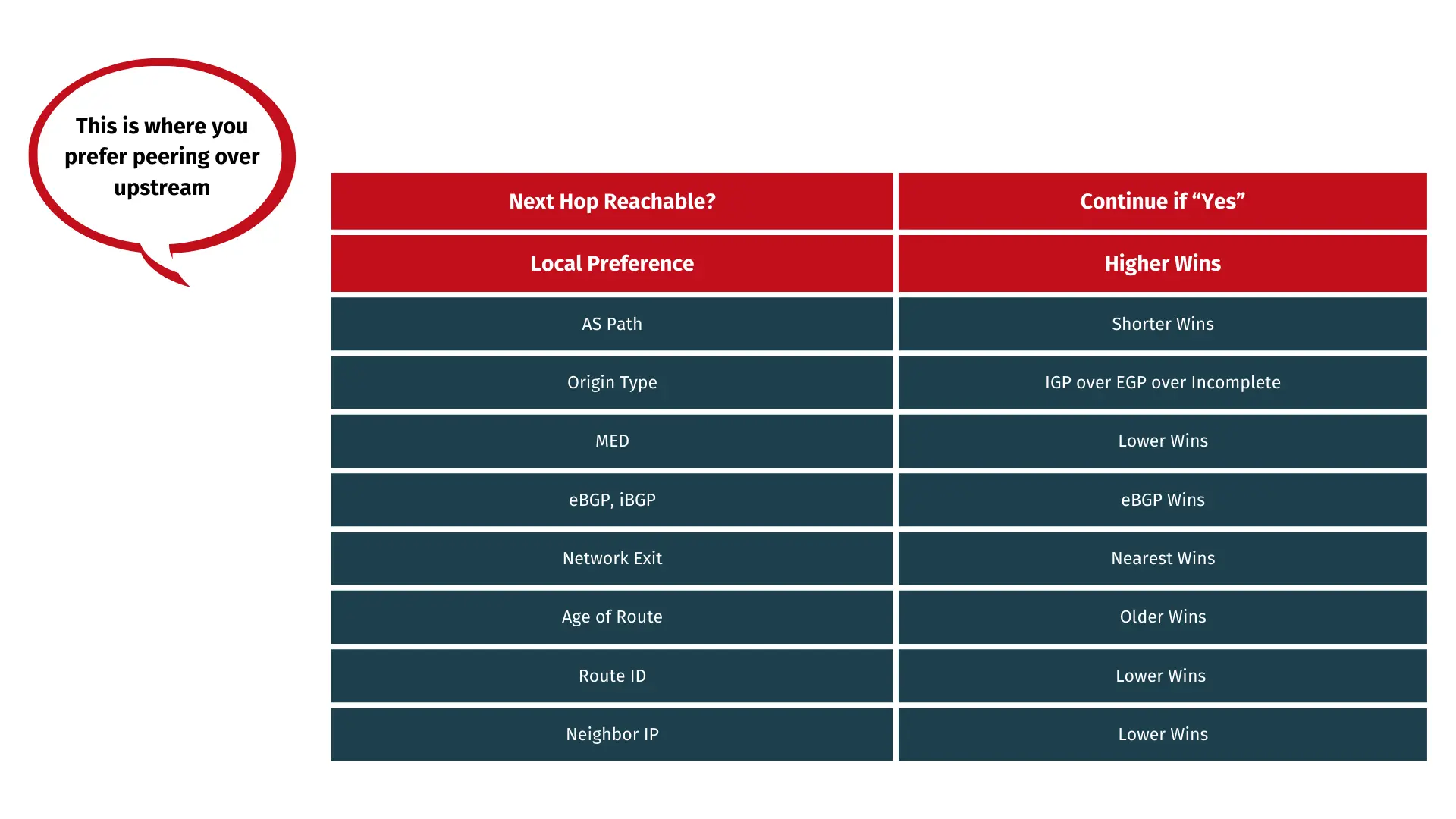
*Important rules are in bold while implementations are more vendor-specific
The router determines the next hop only after selecting the best path. The DE-CIX Academy Knowledge Card on BGP Routing is provided below. You can also download it here

This document contains the Technical Service Description (TSD) for the GlobePEER product. This TSD is part of the DE-CIX INTERWIRE contractual framework for domestic internet access.
This TSD shall apply only to the GlobePEER product. The GlobePEER product may, however, be a prerequisite for other DE-CIX INTERWIRE services. This document contains only technical specifications and documentation. Please consult the GlobePEER SLA for service levels.
The GlobePEER Product requires the following DE-CIX INTERWIRE products for its normal operation:
DE-CIX INTERWIRE Access (see Master SLA and DE-CIX INTERWIRE Technical Access Description (TAD) at any data center location that allows a local connection to the DE-CIX INTERWIRE GlobePEER region.
The following general policies shall apply:
Frame type (ether types) | Policy | Enforcement |
0x0800 – IPv4 | Allow | - |
All other types | Allow | Strict – all frames other than allowed types are dropped |
The following general policies shall apply:
Protocol | Policy | Enforcement | ||
Broadcast ARP (excluding proxy ARP), | Allowed, but rate limited - to 1000kbps | - | ||
All other types, i.e.including, but not limited to: | Discard | Discarded, unless specifically allowed |
Interface configuration
Parameter | Policy | Remarks | ||
IP addresses (IPv4, IPv6) including subnet mask for | IPv4 required | At least the IPv4 address has to be configured | ||
All other types | Allow | Strict – all frames other than allowed types are dropped | ||
IPv6 addresses (link-local & global scope) | No | All IPv6 addresses must be explicitly configured | ||
IPv6 address (site-local) | Not allowed | IPv6 site-local addresses must not be used | ||
Standard MTU | Fixed size | Standard IP MTU size must be explicitly set to |
The customer system’s routing configuration shall include the following policies/settings:
Parameter | Policy | Remarks | ||
BGP Version | v. 4 only | - | ||
AS numbers | Public only | No AS numbers allowed from ranges reserved for | ||
Multiple ASN | Allow | Members may use more than one ASN for their DE- | ||
Route advertising | Maximum aggregation | All routes advertised shall be aggregated as far as | ||
Route advertising – target IP | Advertising router only | All routes advertised across the DE-CIX India exchanges network | ||
Route advertising – registration | Public registration required | All routes to be advertised in a peering session across | ||
IP-address space advertising | With permission only | IP address space assigned to DE-CIX India peering | ||
DE-CIX India advertised routes | Accept | You can safely accept any routes announced by us, |
The DE-CIX India exchanges route server system consists of two servers running BGP. For normal operation, only one is needed
In order for the DE-CIX India measurements of the route server feature to function, at least one connection to one route server must be set up with the following parameters:
Parameter | Policy | Remarks | ||
connection mode | Active | DE-CIX India side is configured as passive | ||
BGP enforce-first-as | Not allowed | Enabled by default, must be disabled manually | ||
AS-Set | Required | DE-CIX India needs the customer AS-Set to build | ||
martians/bogons | Will be discarded |
|
BGP announcement provided by the customer to the DE-CIX India route server is validated for security reasons. For the validation, route databases might be used (e.g. RADB).
In addition to the one route server minimum configuration, the Customer may elect to control outgoing routing information directly on the DE-CIX India Internet Exchange's route server by joining communities. Communities are processed by the DE-CIX India Internet Exchange's route servers by the following set of filter rules:
BGP large communities are also supported (http://largebgpcommunities.net)
Customers are kindly asked to consult the location-specific documentation of existing communities, made available upon request.
Blackholing means diverting the flow of data to a different next hop (the “Blackhole”) where the traffic is discarded. The result is that no traffic reaches the original destination and hence hosts located within the "blackholed" prefix are protected from massive distributed denial of service (DDoS) attacks congesting the connection from the customer to DE-CIX India. Thus blackholing is an effective way of mitigating the effects of DDoS attacks, etc.
DE-CIX India provides the technical infrastructure to allow Blackholing to be set upped and used by customers. DE-CIX India, however, has no control in cases where a customer is accepting these “Blackholed” prefixes.
BGP announcement provided by the customer to the DE-CIX India route server is validated for security reasons. For the validation, route databases might be used (e.g. RADB).
IPv4: /8 <= and <= /24
IPv6: /19 <= and <= /48
Customers advertise their prefixes with a unique DE-CIX India provided Blackhole next hop IP address (BN)
IPv4: /8 <= up to = /32 (if and only if the BN is set)
IPv6: /19 <= up to = /128 (if and only if the BN is set)
Further, the standard announcement checks still apply.
Blackhole next hop (BN) has a unique MAC address (determined by ARP for the BN IP address) e.g. de:ad:be:ef:66:95
ARP resolving for the Blackhole IP next hop is currently served by a host operated DE-CIX India
All edge nodes have a static entry for the unique MAC address
Attack traffic is forwarded from the customer to the service with the static MAC address, traffic is denied.
As a result, all traffic to the attacked and "blackholed" IP prefix is discarded already on the incoming switch, and hence victim's resources (e.g. connection form customer to DE-CIX India ) are protected.